

If you are relatively new to golf and keen to start watching or even playing, this beginner’s guide to how tournaments work will help you have a better understanding of what to expect. In this article, we will look at everything you need to know, including details of the biggest events and how players qualify, what the cut is, how scoring works and much more.
“Golf” is one sport, but as with other disciplines, it comes in a range of guises. A tournament at your local club is obviously going to be very different from the Open Championship at St. Andrews. In this article, we will focus on how most standard pro tournaments work. That’s to say, we will focus on stroke play tournaments that are contested over 72 holes and feature a cut after 36 holes.
Format
If you are watching golf, the chances are it is a tournament as described above. This is the most common format used in major tours for men, women and seniors. The US-based PGA Tour and European DP World Tour dominate the sport in terms of prize money, media attention and viewing figures. Almost all events on these two tours follow the standard format. This can be summarised as follows:
- Four rounds of 18 holes, starting on Thursday and ending on Sunday
- Stroke play – player with the lowest total score over 72 holes wins
- Play-off used if two or more players tie for first, though the format for this can vary
- The field usually contains between 120 and 156 players
- Qualification is determined by a mix of world rankings, past performances, sponsorship invites and qualification tournaments
- The course generally has a par of between 70 and 73, with 72 the most common. Most events see all four rounds at the same course
- After 36 holes, the “cut” sees only the top 65 (and ties) continue into the final 36 holes
- Typically, the first two rounds are played in groups of three, selected at random. The final two rounds see players paired up according to their position on the leaderboard, with the leader placed in the last group each day
Scoring
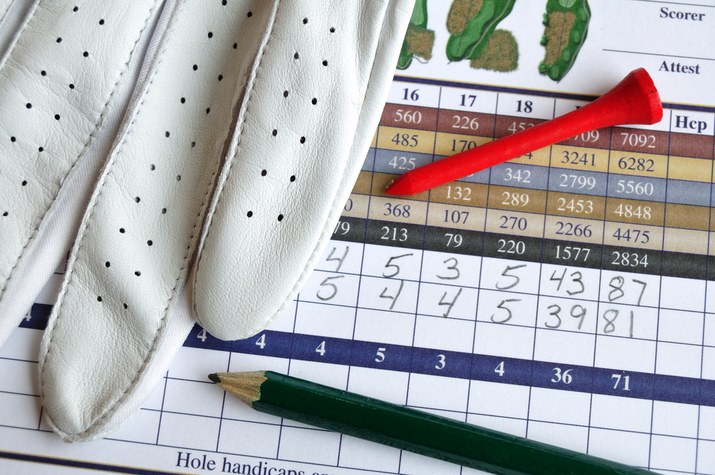
Scoring in stroke play events – which accounts for almost all pro tournaments – is very simple. A player’s total score is taken into account, meaning what they make on every hole is added together and every shot matters. The leaderboard is updated in real time, based on every golfer in the tournament, but this only really matters at the 36-hole cut.
Around half the field is sent home early, with the remaining players competing on the Saturday and Sunday. Essentially, whoever completes all 72 holes in the fewest shots wins the tournament, though the leaderboard and scoring generally reflect a player’s position compared to par, rather than their overall tally (though both are highlighted).
How Long Does It All Take?
There is variation depending on how many players are taking part, but in general the first two rounds of a tournament last most of the day. Depending on the time of year and location of the tournament, almost all the daylight hours are used.
Things can be sped up by using a “shotgun start” or a split tee start. The latter sees half the field start on the first hole and half on the 10th. This can be used if weather delays things, the organisers want to have players grouped in twos, not threes, or to avoid congestion and speed up play. A shotgun start can refer to the same thing and can also mean that all 18 holes are used as starting holes, though this is uncommon in the pro game.
Groups are usually sent out at intervals ranging from 10 to 15 minutes, though on-course incidents can cause minor delays. Each group generally takes around four to five hours to complete their round. This duration has crept up over the years, with four hours or less not uncommon in the past. Things are quicker at the weekend when players compete in twos, but the extended length of modern courses, plus golfers spending longer and longer on their shots, is certainly an issue within the game.
What are the Biggest Tournaments?
Sticking to the men’s pro game, there is no doubt that the biggest events are the “majors”. This term refers to the Open Championship, the US Open, the US Masters, and the US PGA Championship. The first is held in the UK, with the other three tournaments all in the USA. These four events are the most prestigious and attract the best fields and offer the biggest prize funds as well. These events are the ones by which a player’s career is judged and the tournaments all pros dream of winning.
| Month | Tournament | First Played |
|---|---|---|
| April | Masters Tournament | 1934 |
| May | PGA Championship | 1916 |
| June | U.S. Open | 1895 |
| July | Open Championship | 1860 |
Any of these tournaments is a great place to start if you are new to watching the sport. The Open Championship, also referred to simply as The Open, or British Open, and the US Masters, are often the pick of the bunch for most UK fans.
The Players Championship is probably next in terms of prestige and is sometimes referred to as the fifth major. There is a range of other prestigious tournaments too, while the biennial Ryder Cup is a team event that sees Europe and the USA slug it out and is also a huge event on the golfing calendar.
How Does Qualification Work?
Qualification varies considerably between tournaments, though holding full membership of the tour, due to world ranking/FedEx Cup points, or through having won past tournaments, is the easiest way to gain entry to most events. Few, if any, top players enter every single tournament they possibly can, so this often frees up space for others.
On the PGA Tour, winning a major earns exemption (guaranteed tour status) for five years, with most standard wins qualifying for a two-year exemption. Most events also offer a limited number of places to sponsors’ entries. These generally go to upcoming young stars, local players, past winners, golfers whose rank has slipped due to injury, or high-class international players. Further spots, often four, are up for grabs in a Monday qualifier.
A number of “open” events allow just about anyone to enter, at least at the qualifying phase of the tournament. The Open Championship itself is the best example of this, with a series of qualifying tournaments held around the country allowing local pros and even amateurs to try and earn their spot among the best players in the world.
At the other end of the spectrum are invitationals, which also come in different forms. Some have fields of 20 or even fewer, while bigger tournaments have 120. These smaller, elite fields typically feature players who meet very limited criteria, often based on rankings or tournament wins. They may have a reduced cut, or even no cut at all.
Match Play and Team Events
A very limited number of events use the match play format of golf. In this, it is not a player’s tally over 72 holes that counts, but their score on each hole compared to the one opponent they are facing. TV requirements and other factors have limited the number of tournaments played this way, despite their popularity with many fans.
In the past, the European Tour had the highly prestigious World Match Play, while latterly there was the WGC Match Play. However, nowadays those wanting to watch this form of the game have to be content with pairs or team events, the Ryder Cup being the most famous example of the latter.
What about at my Local Club?
Unsurprisingly, local amateur tournaments are very different from the ones featuring Rory McIlroy, Scottie Scheffler and other global stars. These generally take place over 18 holes, though bigger events may be 36. Most are open to all members of a given club, or for more prestigious events, such as a county tournament, they may be restricted to players with a certain handicap or feature a qualification tournament.
Tournaments at this level, especially smaller ones, will almost always use the handicap system, making them of interest to all players, regardless of ability. Additionally, they are more likely to use alternative formats, such as match play or the points-based Stableford system. Many tournaments will feature a range of prizes, with awards for various handicap bands, as well as a scratch prize that recognises the best round irrespective of handicap.